




Mansa Musa the richest man
According to the 2019 Forbes billionaires list, which was published this week, Jeff Bezos, the creator of Amazon, is the richest person in the world. He is the wealthiest man in contemporary history, with an estimated net worth of $131 billion (£99 billion). He is not, however, the richest person in history.
The West African ruler Mansa Musa, who was so wealthy that his lavish giveaways destroyed an entire nation’s economy in the 14th century, is thought to be the rightful owner of that title.
“It’s almost impossible to get a sense of just how wealthy and powerful he truly was,” Rudolph Butch Ware, associate professor of history at the University of California, told the BBC. “Contemporary accounts of Musa’s wealth are so breathless.”Jacob Davidson described Mansa Musa as “richer than anyone could describe” in a 2015 article for Money.com.
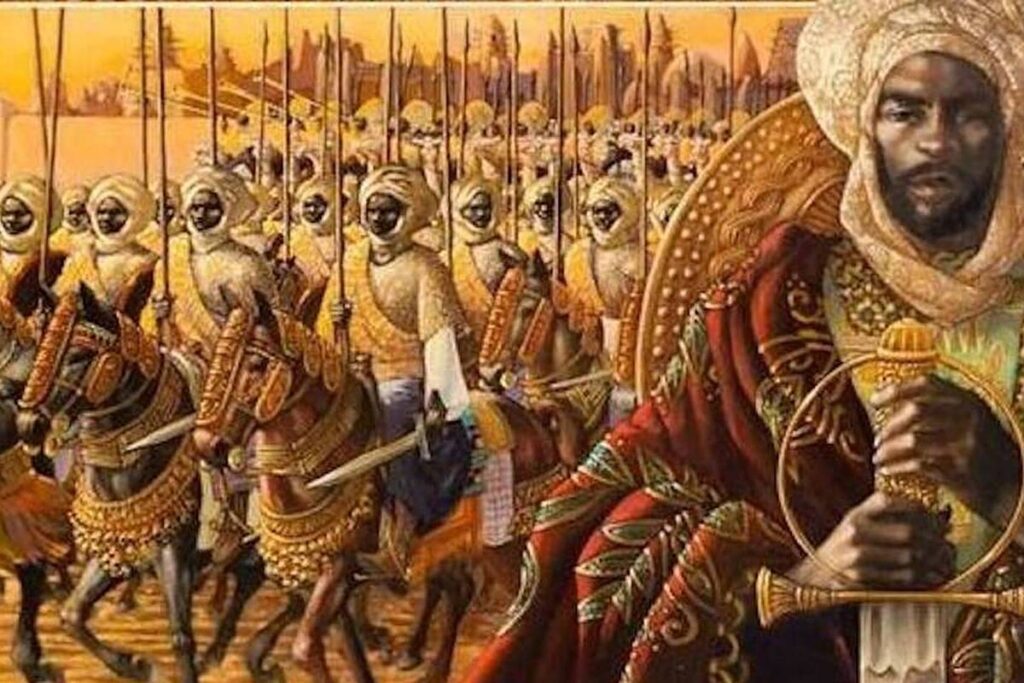
Although the US website Celebrity Net Worth pegged his wealth at $400 billion in 2012, economic historians concur that it is impossible to put a precise value on his riches.
Mansa Musa’s Net Worth
The US website Celebrity Net Worth estimated the 14th-century emperor’s wealth to be $400 billion (Rs 3,313 crore) in 2012. However, historians concur that it is impossible to put a precise dollar amount on Musa’s fortune.
The golden king Of Mansa Musa
Mansa Musa was raised in a royal household and was born in 1280. The empire was ruled by his brother Mansa Abu-Bakr until he abdicated in 1312 to embark on an expedition.
Shibab al-Umari, a historian from Syria who lived in the 14th century, claimed that Abu-Bakr had an obsession with the Atlantic Ocean and what was beyond it. According to reports, he set off on an expedition with a fleet of 2,000 ships, and thousands of people, including slaves, and slaves. They floated away and disappeared forever.
Some others — including the late American historian Ivan Van Sertima — consider the possibility that they made it to South America. However, there is no proof of this.
The kingdom of Mali expanded greatly while he was in power. Timbuktu was one of the 24 cities that he annexed.
The kingdom encompassed portions of what are now Senegal, Mauritania, Mali, Burkina Faso, Niger, The Gambia, Guinea-Bissau, Guinea, and Ivory Coast and spanned for nearly 2,000 miles from the Atlantic Ocean to modern-day Niger. Great resources like salt and gold were available because of the area’s size.
According to the British Museum, the empire of Mali was responsible for over half of the gold in the Old World during Mansa Musa’s rule. And the king owned everything.
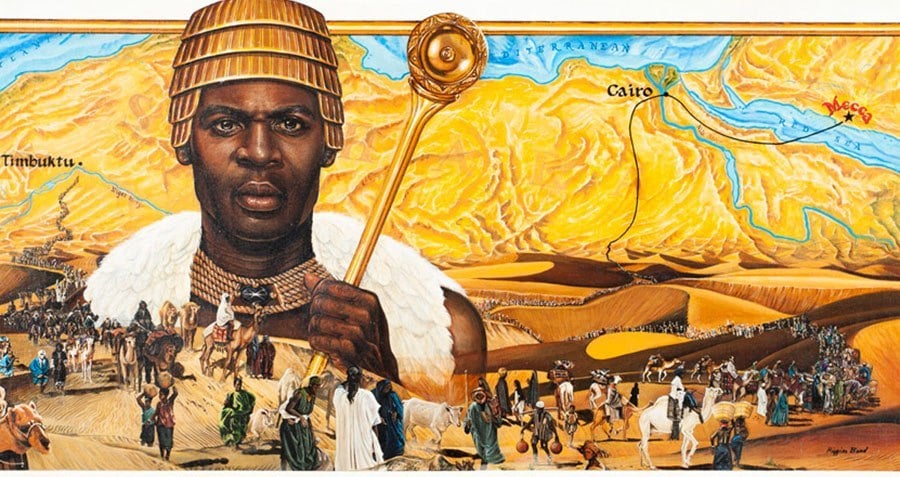
According to Kathleen Bickford Berzock, curator of African art at the Block Museum of Art at Northwestern University, “Mansa Musa had almost unlimited access to the most highly valued source of wealth in the medieval world” as the country’s king, she told the BBC.
Major trading hubs that transacted in gold and other items were also located inside his domain, and he benefited financially from this trade, she continued.
The journey started in Mecca
Despite having a large amount of riches, the Mali empire was not well known. This changed when devoted Muslim Mansa Musa made the decision to travel to Mecca across the Sahara Desert and Egypt.
According to reports, the monarch and a caravan of 60,000 warriors fled Mali. He brought with him a large train of goats and lambs for nourishment, along with his entire royal court and officials, soldiers, griots (entertainers), merchants, camel drivers, and 12,000 slaves.
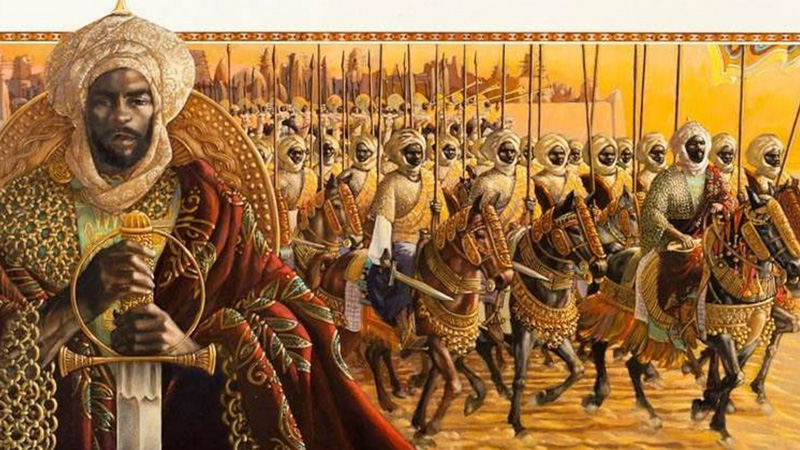
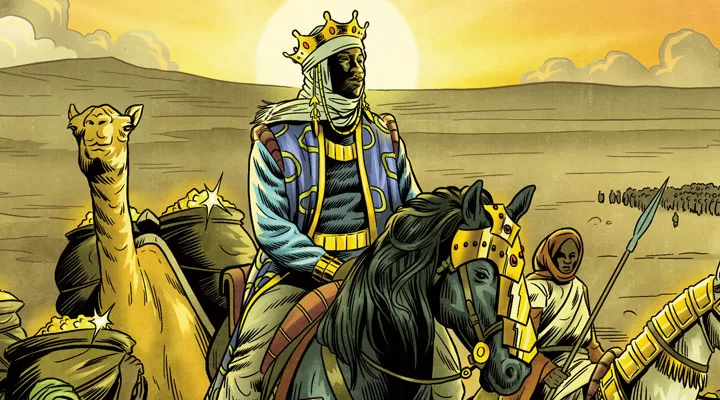
It was a city that was traversing the desert. A city where everyone, even the slaves, was dressed in the best Persian silk and gold brocade. Each camel was pulling hundreds of pounds of pure gold on its back.
The Cairo Gold crash
As a result of Mansa Musa’s lasting influence on Cairo, al-Umari, who traveled there 12 years after the Malian king, recalled how favorably the city’s residents spoke of him. He gave out so much gold in Cairo that the price of the metal fell there for ten years, devastating the economy, as a result of his three-month visit.
According to US-based technology business SmartAsset.com, Mansa Musa’s journey cost the Middle East’s economy roughly $1.5 billion (£1.1 billion) in economic losses as a result of the decline in the value of gold. Mansa Musa traveled through Egypt once more on his way home, and some claim that he attempted to boost the economy of the nation by removing part of the gold from circulation by borrowing it back from Egyptian lenders at exorbitant interest rates. Others claim that he used all of his gold on his expenditures.
He particularly infuriated Malian griots, who are singing history storytellers, according to Lucy Duran of the School of African and Oriental Studies in London.”He gave out so much Malian gold along the way that jails [griots] don’t like to praise him in their songs because they think he wasted local resources outside the empire,” she claimed.
Education at its core
Without a doubt, Mansa Musa wasted or spent a lot of gold while on his trek. But this extravagant charity also attracted the attention of the globe.
Mansa Musa has quite literally put Mali and himself on the map. An illustration of an African ruler sitting on a golden throne atop Timbuktu and holding a chunk of gold in his palm can be found on a Catalan Atlas map dated 1375. People traveled from near and far to catch a glimpse of Timbuktu as it transformed into an African El Dorado.
Due in large part to the exploits of Mansa Musa 500 years earlier, it still held a legendary position as a lost city of gold at the edge of the earth, serving as a beacon for both European fortune seekers and explorers, in the 19th century.
In 1327, Mansa Musa gave the famed Djinguereber Mosque a start. White space for presentations,In addition to a number of Islamic scholars, Mansa Musa also brought an Andalusian poet and architect by the name of Abu Es Haq es Saheli who is largely credited with creating the renowned Djinguereber mosque back from Mecca. These scholars included direct descendants of the prophet Muhammad.
According to legend, the king gave the poet 200 kilograms (440 lb) of gold, approximately $8.2 million (£6.3 million) in today’s money. He not only supported literature and the arts but also architecture and erected mosques, schools, and libraries. People traveled from all over the world to study at what would eventually become the Sankore University in Timbuktu, which quickly rose to prominence as a seat of learning.
Though the history of his reign is mostly unknown outside of West Africa, the wealthy king is frequently credited with founding the tradition of education in that region.
History Of Mansa Musa
Born in 1280, Mansa Musa ascended to power in 1312. According to the British Museum, the empire of Mali was responsible for over half of the gold in the Old World during Mansa Musa’a’s leadership. The emperor was the rightful owner of all that gold. Mali was not a well-known monarchy even though it was the location of a great deal of wealth. However, Mansa Musa led a caravan of 60,000 men and women, including slaves, camel drivers, and royal officials, on a pilgrimage to Mecca. Everyone, including slaves, was dressed in the finest Persian silk and gold brocade. On the voyage, almost 100 camels hauled bags of pure gold.
Mansa Musa Richest Man In History
Mansa Musa, commonly referred to as Musa I of Mali, is regarded as one of the richest people in history. He presided over the Mali Empire, which ruled West Africa throughout the 14th century. The enormous gold and salt reserves in Mansa Musa’s dominion, as well as his control over crucial trade routes, were the main sources of his wealth.
Mansa Musa is well-known for his lavish journey to Mecca in 1324–1325, during which he dispersed copious sums of gold and other treasures and left a lasting influence on the areas he traveled through. His fortune was so great that it greatly affected the economies of the places he traveled, generating brief inflation in several locations.
Mansa Musa’s riches and influence during his time were unmatched, garnering him a reputation as one of the wealthiest people in history. Despite the difficulty of determining his actual net worth in modern terms due to the historical context.
Certainly! Additional information regarding Mansa Musa’s fortune is provided below:
Source of Wealth: The enormous natural resources of the Mali Empire, particularly salt and gold, were the main sources of Mansa Musa’s wealth. Mansa Musa was able to gain enormous wealth because he controlled profitable gold mines at the time when Mali was one of the world’s top producers of gold. He also controlled the trade in salt, which was very important and in demand in West Africa.
Gold and Generosity: Mansa Musa’s displays of wealth and generosity while on his pilgrimage to Mecca are well-known. According to legend, he shared his gold with those in need and the underprivileged, as well as with those he met along the road. His extravagant spending and Philanthropy is alleged to have disturbed regional economics and lowered gold prices in some areas.
Economic Impact: Mansa Musa’s journey made the Mali Empire’s richness and prosperity known to a wider audience. It forged trading ties with other regions and established Mali as a powerful economic and cultural force. The richness of Mansa Musa and the Mali Empire’s robust economy helped to shape the empire’s image as a hub of scholarship and trade in West Africa.
Historical Accounts: Arab and North African historians who chronicled Mansa Musa’s pilgrimage and interactions are among the sources of historical information regarding his wealth and dominion. Ibn Battuta, an Arab scholar and traveler, provided a noteworthy description of his encounter with Mansa Musa splendor of the emperor and the great structures of the Mali Empire were detailed by Ourney.
Overall, Mansa Musa’s affluence and power have permanently altered history. He undoubtedly ranks among the wealthiest people in history, despite it being difficult to determine exact financial assessments.
Here are some more interesting facts about Mansa Musa and his wealth:
Mansa Musa’s fortune is difficult to precisely value, but numerous historians and economists have made an effort to calculate his net worth. According to some estimations, Mansa Musa was among the wealthiest people in history, with an estimated $400 billion in today’s money.
Impact on Cairo’s economy: Mansa Musa passed via Cairo, Egypt, on his way to Mecca, where he dispersed and spent a sizable sum of gold. According to reports, the city had a brief economic crisis as a result of his lavish spending since the influx of gold affected the local economy and drove up prices for products and services.
Education and Architecture: Mansa Musa’s riches were not just utilized for personal expenses. He made significant investments in the urbanization and construction of the Mali Empire. The famed Djinguereber Mosque in Timbuktu and the University of Sankore, which rose to prominence as a center of Islamic scholarship and drew experts from all over the Muslim world, are two notable examples.
Patronage of the Arts: In addition to his financial investments, Mansa Musa supported the advancement of the arts and encouraged intellectual and cultural endeavors. He fostered the creation of libraries and the translation of significant literary and scholarly works, thus elevating the Mali Empire’s reputation on the intellectual and cultural fronts.
Legacy: Mansa Musa’s wealth and his reign had a lasting impact on the region. Under his rule, the Mali Empire reached its zenith in terms of territorial expansion, economic prosperity, and cultural influence. Mansa Musa’s pilgrimage helped to establish Mali as a prominent player on the global stage and increased the empire’s recognition and trade relations with other powerful nations.
Mansa Musa’s wealth and the grandeur of his reign continue to captivate historians and inspire awe to this day. His legacy not only encompasses immense wealth but also the promotion of education, arts, and culture in the Mali Empire.
Read More Article – Click Here